

Why Pomegranates Appear on Hanukkah Menorahs
Look closely at a pomegranate Hanukkah menorah and you may notice a small story hiding among the candle holders. The fruit is more than a pretty detail. In Jewish tradition, it brings together the Land of Israel, the abundance of good deeds, and a long history of decorating sacred objects.
A pomegranate Hanukkah menorah combines that history with the celebration in your home, giving the family something to talk about when you gather to light the candles. Why this fruit? Why so many seeds? And what is it doing on a Hanukkah object when many of us associate pomegranates with Rosh Hashanah?
The answers begin long before the menorah in your home.
A fruit connected to the Land of Israel
The pomegranate appears in Deuteronomy 8:8 among the seven species associated with the bounty of the Land of Israel. Alongside wheat, barley, grapes, figs, olives, and date honey, it belongs to a biblical picture of a land that sustains its people.
It also appears in the account of the scouts who returned with fruit from the land. Numbers 13:23 describes grapes, pomegranates, and figs among what they brought back. The fruit was something tangible that people could see, carry, and share.
On a piece of Judaica, a pomegranate can recall that connection without a map or an inscription. Someone familiar with the biblical passages may recognize it immediately. For someone encountering the symbol for the first time, it opens a simple question: why has this fruit mattered for so long?
That makes it a useful detail to point out to a child. Before discussing its symbolism, start with the real fruit and the many seeds inside it. The object becomes easier to understand when the symbol has something familiar behind it.
Many seeds, many good deeds
Open a pomegranate and its appeal as a symbol becomes clear. Inside one fruit are many tightly packed seeds. Jewish teaching draws on that abundance when speaking about mitzvot, the commandments and good deeds of Jewish life.
Berakhot 57a uses the pomegranate as an image of being full of mitzvot. The comparison gives the fruit a meaning beyond food: a life can contain more goodness than is obvious from the outside.
You may have heard that every pomegranate contains exactly 613 seeds, corresponding to the 613 commandments. That is not a reliable botanical fact. Rabbi Dr. Ari Zivotofsky's discussion for the Orthodox Union explains that the Talmudic comparison is about abundance, not a fixed seed count, while noting later rabbinic references to the number 613.
The symbol does not become less meaningful because actual fruits vary. Its power lies in the picture of fullness. A pomegranate decoration can remind us of many opportunities to do something good, rather than a number we need to prove by counting.
From priestly clothing to Temple decoration
Pomegranates were part of sacred decoration long before today's Judaica collections. Exodus 28:33-34 describes pomegranate-shaped ornaments around the hem of the high priest's robe, with golden bells between them.
The fruit also appears in the description of Solomon's Temple. First Kings 7 describes pomegranate ornamentation associated with its pillars. These passages show that the pomegranate was used in settings where beauty and religious life met.
A pomegranate on a contemporary menorah is not a claim that the object reproduces a Temple artifact. It belongs to a broader Jewish decorative language, one that has carried familiar symbols into new objects over time.
This is part of what makes a decorated menorah rewarding to look at. The candle holders have a practical role, while a fruit, flower, or other motif can invite a conversation about the traditions surrounding the lighting.
Why use it on a Hanukkah menorah?
Pomegranates are familiar at the Rosh Hashanah table, where a traditional Yehi ratzon expresses the wish that our merits increase like the seeds of a pomegranate. But their Jewish meaning is not limited to one holiday.
A Hanukkah menorah gives that familiar symbol another place in the home. The pomegranate can suggest abundance and Jewish continuity alongside the lights of the festival. It is decoration with a story, rather than a requirement for the lighting itself.
The holiday does not require a pomegranate motif. Nor should we assume that every maker uses it for exactly the same reason. The historical associations help us understand what a buyer might find meaningful in the design; they do not tell us the artist's private intention.
For a family, that leaves room for a personal connection. One person may think of Israel, another of a Rosh Hashanah meal, and another of the idea that small good deeds add up. You can choose the object because one of those connections matters to you.
A pomegranate menorah from Amen Judaica
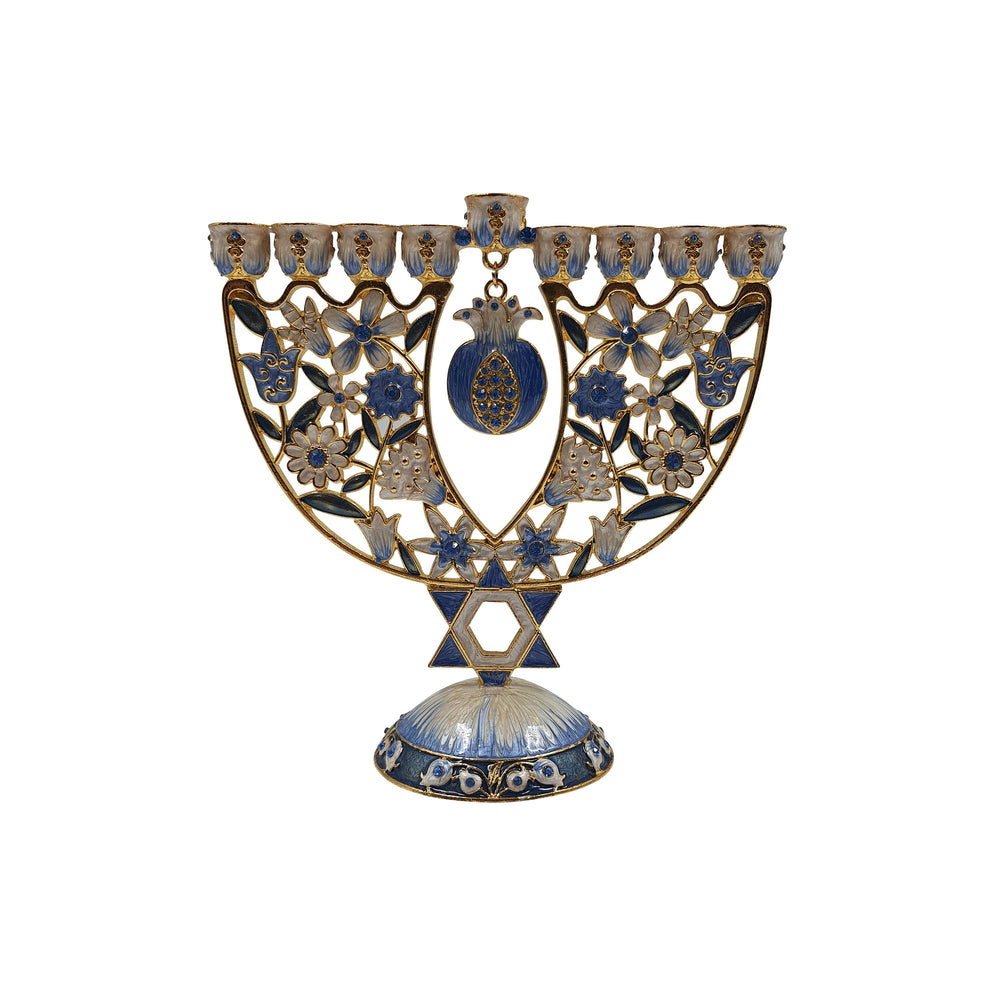
Amen Judaica's enamel-decorated pomegranate Hanukkah menorah puts the fruit near the center of the piece. The product photograph shows a blue pomegranate ornament hanging beneath the raised central candle cup, surrounded by floral details. A Star of David appears above the base.
The listing describes a metal menorah coated with colorful enamel. Its stated measurements are 6.7 inches high and 6.3 inches wide, with candle cups measuring 0.6 inch in diameter. Those details let you compare the actual piece with the space and Hanukkah candles you plan to use.
The central fruit gives you a natural starting point for explaining the symbol. You do not need to turn the lighting into a lesson. A short comment about the seven species or the fruit's many seeds can be enough to make someone notice a detail they had missed.
Before ordering, check the candle dimensions against the holders and confirm any supplies you need. The decorative story and the practical fit belong together: you want a piece you enjoy looking at and can prepare confidently for the holiday.
Choose a symbol you want to bring home
A pomegranate Hanukkah menorah offers a way to bring a familiar Jewish symbol into the eight-night celebration. Its appeal is the connection between a fruit mentioned in the Bible, a teaching about good deeds, and an object your family can use today.
Explore Hanukkah menorahs with pomegranate and enamel designs in Amen Judaica's collection. Read the individual descriptions, look closely at the decoration, and choose the piece whose story you want to share when the candles are lit.